What the Map Could Not Hold
A Story of AxiaMOS
Edition 1.1 · 2026
1. The Line
The sea returned the shoe at forty-third seconds.
The shoe was a child's, yellow, with three painted fish. The wave carried him onto the step, held him at the very edge, as if he was thinking, and pulled him back. A small cleaner, looking like a flattened crab, darted across, caught the shoe with a soft claw and froze. It flashed on its side: “Not sure if it’s trash.”
“I’m not sure,” Leia said.
The crab turned his whole body towards her.
— Is the owner expected?
“We are expecting a child who will be very unhappy without his left leg.”
The crab thought and put the shoe to dry next to the bakery door. In his journal he wrote: “Moved without disposal. Foundation: human testimony." The recording immediately appeared in the corner of Leia’s vision - not because the machine required confirmation, but because she once asked to be shown solutions to city devices if they referred to her words.
The bakery released the smell of hot sesame. The paper birds still hung above the door from the Wind Return Festival. The real wind had been whipping them around for three weeks now; one had lost its tail and now flew worse than the others, but the baker did not allow the repair swarm to replace it.
“It’s more honest,” he said. — The holiday must also grow old.
Leia bought two pies with salted cheese. The payment passed along a thin strip of money, and underneath it opened the usual invitation: “Would you like to report the value received?” She noted the taste and warmth, did not put anything in the “health” line and added a short: “The dough is especially light today.”
She could close the window. Most did this in the morning. Ledger was not offended.
It was not the stars or the average number that glowed on the bakery card. The colored threads showed that over the past three months, people were more likely to rate taste, affordability, and sense of place; less often - health benefits. Below was a warning from the bakery itself: information is voluntary, the sample is biased towards regular customers, confidence is average. Separately, there was a gray thread of environmental consequences—not consumer opinions, but grain, energy, and delivery data. There was a small scar on it: the April shipment of oil came from a farm that hid the water consumption. The compensation ended long ago, the scar remains.
Leia put one pie in her jacket pocket and walked towards the embankment.
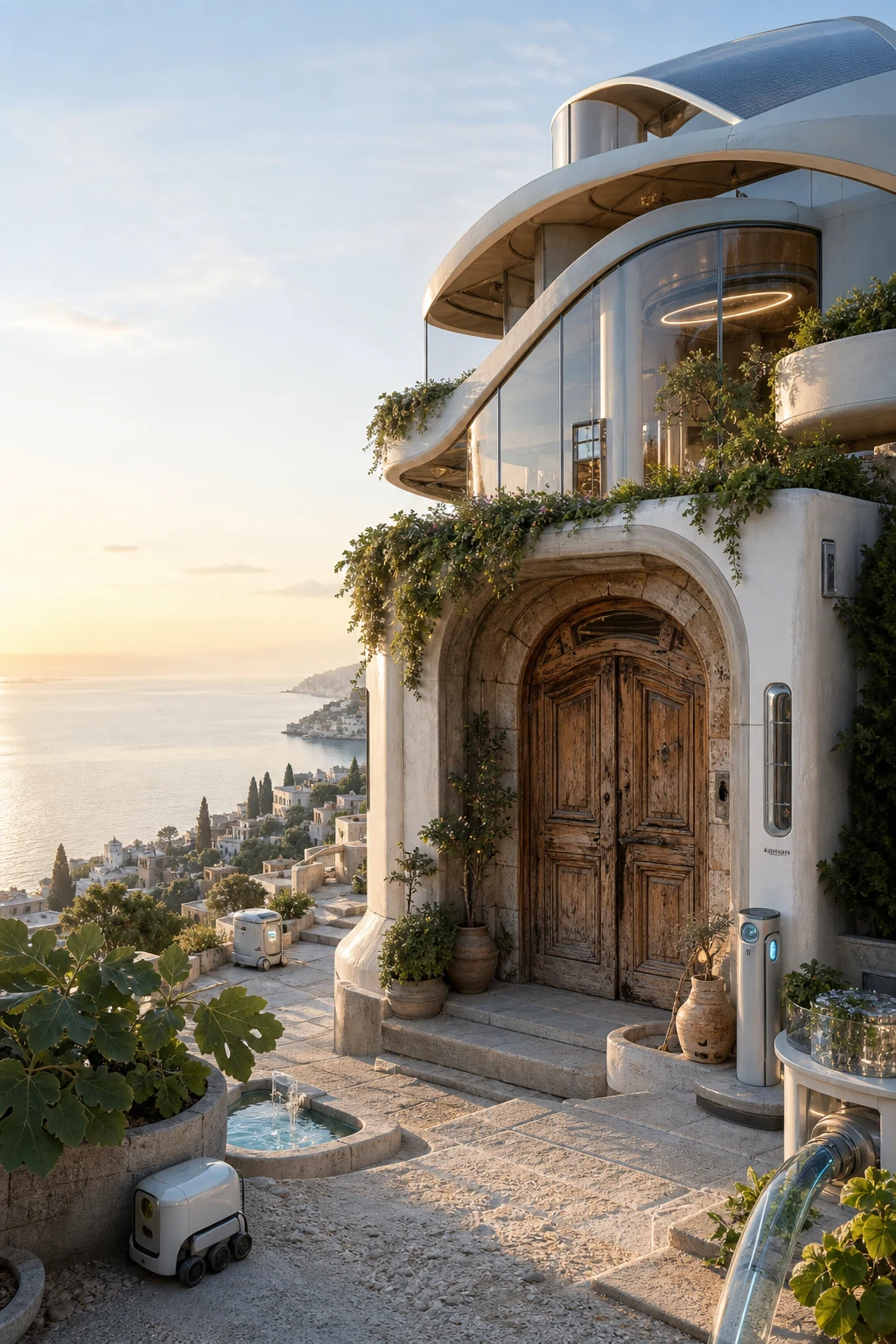
The area was called the Lower Garden, although there were few gardens here, and the lower sea gradually took over everything. The houses sloped down to the water in white terraces. Between them grew fig trees, cables and old irrigation pipes. New houses themselves changed the shade, caught moisture and released repair insects at night. The old ones held on to habit, thick walls and the care of their neighbors.
Ilan was sitting on the parapet. Nearby lay an open container with samples: porous stone, a transparent film, a lump of brown foam and a gray material that breathed like gills.
“You're late,” he said.
- For forty-three seconds.
“During this time I managed to stop loving you and falling in love with the sea.”
— It returned the child’s shoe. He has good behavior today.
Leia handed him the pie. Ilan took a bite, closed his eyes and after a pause said:
- Too tasty to be useful.
“I have already made just such a contribution to public knowledge.”
A long green shaft walked across the water in front of them. Far away in the bay, wave-cutting robots were working: black dots rearranged themselves in chains, broke the wave and dispersed again. Their route, energy consumption, hull supplier and current mandate were open to anyone. Ilan liked to look not at the robots themselves, but at the transparent traces of their decisions. Sometimes he found them funny.
“Number seventeen again considers the cormorant a temporary obstacle,” he said.
— Cormorant thinks number seventeen is a permanent idiot.
“Their argument lasts longer than our romance.”
Leia leaned against his shoulder. The gill material in the container sucked in air and clicked softly.
- What is this?
— A wall that will later become soil.
- Does she know?
- For now he thinks it’s a package.
Ilan designed temporary environments. This was the name of his work in mission agreements. He himself said that he teaches things to stop being themselves in time. His designs did not strive to outlive people. They knew how to figure things out, to become bridges, shelters, gardens, and sometimes nothing.
- Do you have a meeting today? he asked.
Leia didn't answer. She took a porous stone from the container. It turned out to be warm and unexpectedly light.
- Do you remember our first wall? - Ilan asked.
“It wasn’t our wall.”
— You were holding a lantern.
— While you spent three hours proving to the machine that curvature is not a defect.
— Consequently, I participated in the design.
They met five years ago when a storm knocked out part of the old staircase leading to the water. The construction swarm restored the perfect identical steps every time, and every morning the residents rearranged the two lower ones, because fishermen were sitting on one, and children were jumping into the sea on the other. The cars have seen repeated vandalism. Ilan saw two features that were not included in the order.
Leia then collected evidence of the use of the stairs. Ilan considered her too serious. She considered him a man capable of turning the three stages into a philosophical war. A week later, they presented a new project together: a staircase that became a bench at low tide, and during a storm, it itself dismantled the lower part.
On the opening day, Ilan kissed Leia behind the panel warehouse. An inspection apparatus buzzed above them and politely asked if they were work in progress.
The steps still existed. Every spring the sea changed them a little, and the swarm asked the inhabitants whether they should return to their previous form. Residents usually answered “no.”
“If the area is closed,” said Ilan, “the stairs can be moved.”
“Then it will be another staircase.”
“Mara is a bad influence on you.”
- She thinks the opposite.
He took a thin strip of candied peel from his pocket and separated it with his teeth. He put half of it in Leia's mouth. The candied fruit was bitter, the salt remained on his fingers. The sea beyond the parapet was breathing heavily, but the morning still felt like their own.
- Do you have a meeting today? - he asked again.
- At ten.
- Big?
- Ordinary.
Ilan looked at her. He knew how to remain silent so that the lie became uncomfortable.
“Tentative shoreline,” Leia admitted. — New model.
- AND?
- I haven’t seen it yet.
- But you already know.
She knew. In recent winters, the sea did not attack the Lower Garden - it figured it out. Each storm found a weak point, remembered and returned more accurately. Houses raised thresholds, streets became channels, robots patched up overnight what had previously taken months to repair. Therefore, people are accustomed to thinking that the area has been saved. Automation created a dangerous kind of hope: the breakdown disappeared before it could become a memory.
A thin red line lit up on the parapet between them.
She passed through the bakery, the old laundry, the clock square, and Grandma Mara's house. Then it climbed up the wall, crossed Ilan’s palm and went out.
Nobody projected it. It was the city's emergency beacon: at ten in the morning a new acceptable risk limit was published, and street surfaces were checked in advance for the visibility of the signal.
Ilan slowly removed his hand.
“An ordinary meeting,” he said.
The cry of a cormorant came from the sea. Breakwater number seventeen made way for him.
2. The House That Woke Last
Grandma's house didn't like mornings.
The shutters did not open simultaneously, but one at a time, from east to west. The kitchen only warmed up the floor after it heard footsteps. The water circuit grumbled every time that the pressure was below normal, and every time it refused to be replaced: Mara had put a ban on “improvements without breaking” twelve years ago and had confirmed it with the same thumbprint ever since.
“Things should have the right to grow old,” she said.
“Things have no rights,” Nomi answered.
“That’s why they live with us longer than humans.”
When Leia came in, her sister was sitting under the table, sorting out the home cook.
“He burned the rice,” Nomi said.
- Once in nine years.
- All the more suspicious.
The cook stood on three legs, opening the side panel. His manipulators hung helplessly along the body. Inside, Nomi was digging around with a wooden stick.
- Don't touch the power part.
“She passed out on her own.”
— What about the owner’s permission?
- Grandma said: “Get this crap out of the kitchen.”
From the next room came:
- I didn’t specify the method!
Leia sat down next to him. An absurd chain was discovered in the cook's journal: a nightly update of the city network changed the designation of the rice variety; the cook mistook the local "White 12" for an imported "White Twelve", asked the store for humidity, was refused due to an expired access contract, priced it according to last week and increased the heat.
“Three systems acted wisely,” Leia said. “That’s why breakfast died.”
Nomi nodded contentedly. She was fifteen, and technological disasters were making the world understandable again.
— I will send the chain to the manufacturers.
- I have already.
- And what did you note?
— That a cook is valuable as a teaching aid.
Leia laughed. New evidence has appeared in Nomi's personal ledger. It did not increase or decrease the “score” of the car. There was no score. The manufacturer will see what value the girl received from the device, what she expected, and where the gap occurred. If Nomi allows, other buyers will see her message in the public selection. If not, it will remain available to her and the manufacturer as part of the overall deal.
The cook belonged to Mara, not the city: she had bought it with money twelve years ago and was still paying a small service fee to the private workshop. Only a protected minimum kitchen was free for those who could not cook for themselves. Mara rejected this minimum on principle - and every month she grumbled that her social dividend had again gone to the machine that spoiled the rice. Nomi received money for bugs found if the workshop accepted the fix. For today's breakfast, all she deserved was glory.
— Did you also appreciate your relationship with the chef? - Leia asked.
“He hasn’t asked for feedback yet.”
- Smart.
Mara entered the kitchen wearing a blue robe. She didn't use a morning aid and was proud of herself for forgetting to take her medications.
- What's wrong with the sea? she asked.
Leia looked at Nomi. The sister got out from under the table and closed the cook's panel.
— The border is published at ten.
— Borders are published by people who have nothing better to do.
- This one is water.
Mara poured herself some tea. The cup shook in my hand, just a little. Dom noticed and suggested a stabilizing ring. Mara rejected the offer with a glance.
— Water doesn’t publish anything. She comes.
A city message was revealed on the wall. Not alarm - a calm white card with the coat of arms of AxiaMOS and a list of sources. “Revisiting coastal risk. Lower Garden. Version 18.4. Publication of model, assumptions, discrepancies and transition options - 10:00. No decisions have been made regarding relocation.”
Below were the names of government agents. Not human names, but positions: Infrastructure Sustainability Agent, Environmental Balance Agent, Housing Affordability Agent. Each one has a version, a mandate, a term of office, a training log, a list of challenged assumptions and a red recusal button.
“You see,” Mara said. - Nothing has been decided yet.
Nomi looked at the red line that had already appeared on the kitchen floor plan.
“Only the house was cut in half.”
At ten o'clock the city's surfaces darkened for a moment. Not because the message was mandatory: this is how the district once decided to announce information related to general security. Then a shore appeared on the wall - not a map, but many translucent futures.
In one sea it reached the square in seven years. In another - in twelve. The best-case scenario left Grandma's house dry for the rest of the century, but his confidence was marked by a thin dotted line. The worst one eroded the slope over two winters.
The government agent spoke in a quiet voice, chosen by the residents of the area five years ago. The voice had no gender and no attempt to console.
- No scenario is a prediction. The border shows areas where the total risk has gone beyond the established corridor. Life Safety Weight - current version 31. Ecological Reversibility Weight - version 12. Local Lower Garden weights are available here. The next public review of the government's scales will begin in nine days.
Mara snorted.
— Will the sea wait for the vote?
“No,” Nomi answered. “That’s why we’re not voting for the sea.”
Three options appeared on the map. The first is to continue to defend the area for another four years, preparing for a gradual resettlement. The second is to begin the transition immediately. The third was to build a new deep-sea defense system that left the houses in place but destroyed the tidal gardens in the nearby bay and transferred some of the risk to the East Knot.
The third option was crossed out. Not prohibited - found to be incompatible with the current limits on external harm.
Leia opened a professional projection. It had more detail and less color. Between the numbers, she saw what she was afraid of: Mara’s house belonged to the first stage. Ilan’s family is part of a group that was proposed to be moved to Arden, on the northern plateau, four hundred kilometers away.
Arden was a good place. That's what made everything worse.
“I’m not going anywhere,” Mara said.
- This is not a decision yet.
“Then my refusal is not a refusal yet.”
Nomi enlarged the map.
- Who are we with?
Leia didn't answer right away.
And in this short pause, the house understood before anyone else.
He closed the east shutters to keep the sun from heating up the empty room of the future.
3. Testimony
Chairs were brought to the square, although most residents were able to participate from home. The old people believed that a law discussed without the smell of neighbors inevitably turns out bad. Young people came to see the old people. Children came from behind the cold water dispensers, which added mint to it on public hearing days.
Leia stood at the registration table and tried not to look for Ilan.
Before the mission began, each continuity supervisor disclosed connections that could affect his work. Kinship, property, financial contracts, participation in organizations. Personal intimacy was disclosed only to the independence body itself and was not published without the consent of both. The system asked Leah: “Is there a non-public connection with the subject of the transition?”
She clicked yes.
A second line appeared: “Does communication affect the ability to complete an assignment?”
Leia held her finger.
“If you look too long, the correct answer will not appear,” said the woman behind her.
- I know.
She noted: “unknown.”
The system accepted the response. During the review, Leia could collect evidence and explain options, but was deprived of the right to certify the final dependency map. The decision was unpleasant and therefore calmed her a little.
Ilan was sitting near the fountain with his mother, two brothers and half of his street. Their group already existed in the ledger as a voluntary association - not a list of affinity, but a joint statement: "We want to be considered together in the transition." The state did not know who was bringing food to whom, who was quarreling with whom, or who was holding the spare key. It knew only the border that people drew themselves.
When Leia approached, Ilan's mother hugged her.
-Are you coming with us? - she asked without greeting.
“Samira,” Ilan said quietly.
- What? We need to know how many rooms there are.
- There is no decision yet.
— Rooms appear before solutions. Then there are always not enough of them.
Leia sat down next to him. A representative of the municipal assembly stepped onto the platform - a living person chosen by lot for one season. His name was Thomas, he repaired musical instruments and was noticeably afraid of the microphone.
“I will open the hearing,” he said. — Agents can be interrupted through a common channel. You can interrupt me with your voice, but preferably one at a time. All models have offer status. All personal testimonies remain in the access area chosen by the authors. We are discussing transition options, not the value of anyone wanting to stay.
Three government agents appeared above the platform in the form of simple figures of light. AxiaMOS long ago abandoned human faces for public systems: people too quickly began to love the beautiful and forgive the charming.
The Infrastructure Resilience Agent spoke first. He showed not only the conclusions, but also his own discrepancies. Two models considered the breakwater sufficient for four years, one for two, and one refused to respond due to incomplete data on the underwater soil.
- Why do you still offer four? - someone shouted.
“I don’t suggest it,” the agent replied. — Four years is the upper limit of the first option, subject to annual review. The most prudent enforceable limit is twenty-two months.
- So, write twenty-two!
Thomas raised his hand.
— The amendment to the submission form has been registered.
A mark appeared next to the agent's figure. Anyone could open it and see who was required to respond and by when. If the answer does not appear, inaction will also become an event, and not emptiness.
Then the residents spoke.
The baker reported that his oven could not be moved without losing the leaven living in the wall. The agent wrote down the material dependency and specifically asked if the baker would like to provide feedback on the value of the sourdough starter. The baker refused.
“You still won’t understand,” he said.
“The probability of this is high,” the agent replied.
The square laughed.
The woman from the sixth house said that every day she accompanies her blind neighbor to the sea. She did not give his name and did not agree to confirm the relationship. Instead, their group expressed a need: a safe route together and the ability to live within eight minutes of each other.
Leia noted the conditions. Not people - the boundaries of acceptable transition.
Ilan was silent until Arden appeared on the model.
The new settlement lay among the low northern hills. Houses there could change layout, water was abundant, transport to the center took fourteen minutes. The resettled group did not receive monetary compensation, but a choice of sites, construction resources and a share of future land rent. Everything seemed fair.
“Show me the way back,” said Ilan.
— Specify your request.
“What will happen to Arden if in ten years the coastal model turns out to be wrong?” Can we go back?
— Physically, yes. The right of return is retained. Restoration of the original area is not guaranteed.
— That is, the path exists only on the map.
- Right.
- Then this is not a transition. This is the end with good transport.
Leia saw Samira place her hand on his shoulder. Ilan did not shake it off, but began to sit straighter.
The ecological balance agent revealed a layer of tidal gardens. If you stop protecting the Lower Garden, the sea will create shallow water in a few years that can absorb the winter wave. On the map of the future, fish swam where the bakery now stood.
“Beautiful,” said Ilan. — Especially if you don’t know the names of the streets.
After the hearing, people left testimonies. Some - publicly. Some are for trial only. Most did not leave at all. The ledgers were not filled with up-and-down votes, but with disparate accounts of value gained and value lost.
Leia saw a request from Ilan.
“Would you like to give feedback on our relationship over the past month?”
This was a common personal ledger feature that people rarely used and always felt awkward about. The recipient could describe the value of the relationship to themselves only, share it with another, or leave a joint testimony. No government agent had the right to see the contents. Even the fact of refusal did not leave the boundaries of the two.
Leia opened the request.
In the “received” line she wrote: “Feeling of the future.”
In the line “lost”: “The certainty that it is common.”
She looked at the permits for a long time and chose: “show Ilana.”
His answer came almost immediately.
“I have not yet agreed to become the past.”
4. Weights
On the ninth day, the state asked Leia what should be more important to him.
She was peeling a pomegranate over the sink. Nomi was trying to get the window cleaner to recognize the pigeon's nest as real estate, and Mara was watching an old play in which the live actors for some reason pretended not to notice the audience.
The notice of the scale revision lay among everyday things: a filter delivery deadline, a birthday invitation, a report that the cook no longer confuses two types of rice. Leia put it down. The state reminded once and fell silent.
- Will you vote? - asked Nomi.
- Later.
— Everyone votes later. Therefore, the last hours look like the end of the world.
- You can't do it yet.
- I can watch.
Open votes in AxiaMOS meant that the question, the arguments, the models of consequences, the sources of the money, the history of amendments and the final tally were open. The choice of a specific person remained secret. Mara said that this is not openness, but decency.
This time, it was not the law that was being reviewed, but the weights of the state framework for the next three years: what sensitivity to give to environmental reversibility, infrastructural sustainability, housing affordability, intergenerational longevity and other axes. Nearby lay the economic corridor: how much risk society is willing to leave to entrepreneurs for the sake of new solutions, what margin of sustainability must be preserved and at what cost to maintain the competitiveness of foreign trade. It was impossible to reduce everything to one number and choose a winner. Citizens distributed limited weight, seeing ranges of consequences and the cost of concentration.
Leah opened the public projection. Millions of voices formed a slowly moving relief. Ecological reversibility was growing. The speed of transitions decreased. Housing affordability remained almost stagnant. Not a single vote was visible, but each counting operation was reproduced independently by the seven public nodes.
— If we increase the proximity of settlements, will Arden become less likely? - asked Nomi.
— Proximity is not a state axis.
- Why?
— Because the state should not decide how important it is for a person to live next to another person.
- Comfortable.
- For whom?
- For the state. It is not responsible for broken hearts.
Mara turned off the performance.
— The state should not be responsible for hearts. It should not step on them with its boot.
“He doesn’t have boots,” Nomi said. - He has robots.
Outside the window, the washer carefully circled the nest. He accepted Nomi's statement in part: the nest was not real estate, but became a temporarily protected breeding site. A dirty arc remains on the glass.
“Here,” Mara said. — Civilization.
Leia distributed her weights. A little more - the ability of decisions to be reversible. Slightly less - the speed of infrastructure renewal. She understood that she was not voting about her own district: the new version would take effect too late and could not be applied retroactively. That is why her choice seemed more honest and useless.
Once fixed, the voice disappeared from her own interface. All that remains is proof that it has been accepted and taken into account. Even she could not present the contents of the ballot to another person and receive a reward for it.
- Will you show me? - asked Nomi.
- I can’t.
- What if you really want to?
“Then I especially can’t.”
Late in the evening Ilan came. He brought the gill material and put it in a bowl of water. The material opened into a pale flower.
“I was offered Arden,” he said.
- I know.
- Not as a resident. As a designer.
Leia stopped separating the pomegranate seeds. Red juice ran down my fingers.
- How long?
— The first contract is eighteen months. Then, if the group chooses a project, another three years.
- Did you agree?
- No.
- Refused?
- Not either.
He smiled, but the smile could not be contained.
- Tell me what to do.
- I can't.
— As a curator?
- As a person who will then live next to the consequences of your decision.
- This is called “tell me.”
Mara walked through the kitchen, took one piece of pomegranate and left. Nomi sat under the table with the cook and pointedly did not hear anything.
Leia wiped her hands.
“If you don’t go, your mother will stay here because of you.” Your brothers will be divided. Half your group will choose the less secure option.
- If I go, you will stay here.
- Yes.
- Is that all?
- No. But this is the only part that I have the right to decide for myself.
Ilan looked at the material revealed in the water.
“We have built a state that can see harm between millions of people,” he said. “And it can’t see the four hundred kilometers between the two.”
- Maybe. He simply has no right to call them wrong.
“This doesn’t make it any closer.”
He left, forgetting the material in the bowl. By morning he drank all the water and turned into a thin gray bowl.
Leia entered the resulting value into her ledger: “He asked me to choose.”
Lost: “I wanted to have the right.”
This time she didn't show the recording to anyone.
5. The Empty Space Between People
The trial evacuation began at five in the morning and immediately broke down.
Not catastrophically. In AxiaMOS, large systems were rarely broken with one beautiful gesture. They started doing a lot of the right things in the wrong order.
The transport capsules arrived three minutes before the houses opened. Mara's house refused to release the medical chair because it considered it a training alarm. The forklift robot had no right to argue with the house and submitted a request to the owner. Mara slept without an interface. The request went to Leia, but her powers as a relative conflicted with her role as a curator. While the independence body was issuing a one-time permit, Nomi's school swarm occupied the narrow passage: the children decided to test whether the autonomous class could continue the lesson while moving.
Smog. The whole area stood still, and the children studied hydrodynamics.
“This is hydrodynamics,” Nomi said, pointing to the traffic jam.
At an intersection, two robots were arguing over who should give way. Their negotiations were open and impeccably polite.
"My passenger has a medical priority of 0.71."
"My route serves an aggregate priority of 3.84."
“Your aggregate priority does not give precedence over your individual threshold.”
"Agree. I request a human solution."
“Both of you back,” Leia said. — Clear the cross passage.
— Foundation?
— You are optimizing a queue that shouldn’t exist.
The robots drove off. The cork disintegrated in forty seconds.
Leia recorded the event in the transition map: "Local priorities create deadlock." The machines attached their own logs and marked her solution as successful. A minute later, one of them requested permission to use this example in the next routing update.
— Use without faces or addresses.
- Accepted.
Ilan watched from the roof of the bus stop. He didn't officially participate in the test, but he brought his little construction swarm - six flat machines capable of turning panels into decks and bridges in minutes. When Mara's chair got stuck on the old stairs, the cars folded into a ramp before Leia could ask.
“Undeclared interference,” she said.
— Undeclared staircase.
— The staircase was in the model.
- So the model underestimated her.
Mara drove between them.
- If you are finished courting, I would like to evacuate.
By noon, all residents reached temporary points. Formally, the test was successful: not a single material minimum was violated, medical routes were preserved, and the average time turned out to be better than the standard one. There was a green stripe on the public panel.
Leia looked at the square of the temporary center and saw something else.
Mara was brought to the eastern sector. Her neighbor Aza - to the west. A blind man found himself next to strangers because the woman who went to the sea with him every day did not name their connection. The baker was settled near an industrial kitchen, where everything was more convenient than his oven. The children found each other instantly; the adults began to disintegrate into single dots.
No one was abandoned. Water, food, communications, medicine and personal space were provided. That's why the report didn't lie.
Leah opened a layer of voluntary groups. He showed large associations, but there were voids inside them. People did not want to tell the state who needed whom. And they were right.
“The system saw everything it had the right to see,” Thomas said next to him.
- And she did everything right.
- You say this as an accusation.
- Like a diagnosis.
— Should we expand the collection?
- No.
The answer came too abruptly. Thomas raised his palms.
- Then what?
Leia looked at the people. Mara had already found Azu and scolded the transport robot for taking them on different routes. Ilan sat on the floor with the children and assembled a tower from packaging panels. Samira distributed food to everyone except herself.
“We don’t need a relationship map,” Leia said. “We need a way for people to transfer them without showing us.”
- It's like a map that you draw with your eyes closed.
- No. It looks like a door. We don't have to know what's in the room so as not to block the exit.
She formulated a new test condition: residents should be able to create small closed groups of shared movement themselves, and the system should only check the compatibility of requirements, safety and the absence of coercion. The content of the communication is not requested. One person can belong to several groups without explaining why.
The housing affordability agent responded within seven seconds:
“The proposal is acceptable. Risk discovered: overlapping closed groups could restore the social graph of housing choice.”
“Then the calculations must be done by people,” Leia said. — Only restrictions come out.
“A new protocol will be required. The design period is from six to nine months.”
There were four days left in the winter storm season.
Ilan came over when the test was over.
- I saw your amendment.
- She is public.
- Not a correction. The way you looked at people.
— This is not yet a provided data format.
— I could make a prototype.
— You design the walls.
— I design something that ceases to be walls.
- Ilan.
“I was still offered eighteen months of work for my own exile.” Let me at least start packing.
She wanted to say that this is not an exile. Then she looked at the baker, who was holding a container of sourdough in his hands, like an urn containing ashes.
“Bring the access architecture,” she said. - Not a pretty demonstration. And don't touch real data.
— Are you talking like a curator now?
- As a person who needs an answer before winter.
6. The Transparent Glass Act
Ilan's prototype was called the Ark, and Leia immediately demanded that it be renamed.
- Why?
“They take the chosen ones into the ark, and drown the rest.”
- Then “Suitcase”.
— There are things in the suitcase.
- “Pocket”?
— You can forget your keys in your pocket.
As a result, the system remained without a name. People created closed circles on their own devices, indicating maximum distances, compatible routes, accessibility needs, and desired public spaces. Personal connections were not sent anywhere. A set of conditions came out like: “These seven participants unknown to the system must receive housing within six minutes of each other; two need a barrier-free route; four have access to a shared kitchen.”
The seven members could check that their demands were being taken into account, but no one on the outside could see why they were together.
The first test was carried out on Ilan's family. The system immediately detected a contradiction: Samira wanted to live close to both sons; the eldest son is no closer than twenty minutes from his mother; the younger one is next to the older one; Ilan - near the sea and Leia, who did not participate in the circle.
“Great,” said Ilan. “We invented the mathematics of family dinner.”
The system was not looking for an ideal solution. She showed the incompatible conditions to the participants themselves and asked them to decide which ones to change. Samira reduced the requirement for closeness to her eldest son to fifteen minutes. The eldest raised his to fifteen. Both pretended that the other gave in.
Leia watched and felt almost happiness—cautious, working. Then a bill on the transparency of government models appeared on the public channel.
Its official name took up four lines. Everyone called it the Clear Glass Law.
After several cases of commercial influence on government schemes, the law prohibited changing the structure of significant models under the guise of technical updating. Any new category of data, deletion of a category, or change in the method of assessment was subject to public comment, independent review, and ratification by a citizen jury.
The Thalass consortium supported the law. It was he who financed most of the research on the coastal zone.
“Of course I supported it,” said Ilan. — Their model is already inside the glass. Now the glass will simply become thicker.
Leah revealed the history of the bill. Each edit was listed next to its author, meetings, funding and forecast of consequences. In the third week, someone added an exception for “already existing certified models.” The author was the parliamentary group of the northern territories. Thalassa specialists were listed in the meeting log.
This was not proof of capture. People met, convinced each other and had the right to do so. The parliamentary group published an explanation: re-testing thousands of existing models would stop infrastructure projects. An independent agent confirmed the risk of delays. Another agent noted that the exception would allow the old accounting categories to remain in place forever.
The explanations were not accompanied by comments, but by structured objections and ordinary human curses. The first ones were easier to analyze. The latter hit the mark more often.
In the evening a debate took place on the square. State agents stood as open processes: anyone could reverse the chain of reasoning, replace an assumption, and see if the conclusion changed. Several schoolchildren staged a competition to see who could get the agent to admit uncertainty with fewer questions.
Nomi won in four.
“If the classification of a change is chosen by the system,” she asked, “can a change in the classification system be recognized as technical by the system itself?”
The legislative influence agent responded:
- Yes. This is a recursive conflict of authority. Not eliminated in the current text.
The people in the square laughed, then it became quiet.
Nomi's amendment could not be automatically registered: it did not have full legislative capacity. Thomas offered to become a procedural guarantor without assigning authorship. Nomi agreed after making him read the terms out loud.
“I rate your guarantee as cautiously helpful,” she said.
“Thank you,” Thomas replied.
- This is not a compliment.
Voting lasted two days. Leia didn't know how Ilan voted and didn't ask. They sat side by side on the steps, watching how the open calculation was made up of secret decisions. Support for the exception was slowly declining. Shortly before the closure, the parliamentary group itself recalled it and introduced a transitional schedule for checking old models.
The law was passed.
That same evening, Nizhny Sad was left without drinking water for eleven minutes. The old pump blocked the pollution before the state sensor, and the Thalassa backup line took over the load automatically. Both entries appeared on the public dashboard: harm prevented and service provided. Residents who had just criticized the consortium in the square noted the high value of the backup line.
Thalassa remained a private operator: it hired people, built equipment, made profits and lost contracts. But the control core of the water automation belonged to the civil trust. When the network became indispensable, the state did not take it away: the terms of the transition were announced in advance, an independent assessment determined compensation, and the previous owners were left with a share and the right to compete for operation. Now the water fee diverged along three visible channels - maintenance, operator income and rent of the common core. The latter was returned to the public fund only after payment for the service. If residents stopped buying above the protected minimum, no imaginary rent appeared in the report.
“That’s why I hate them,” said the baker. “They turn out to be useful all the time.”
Ren Var came to check the switching personally. He stood at the pump with his sleeves rolled up and drank water from a paper glass.
“My daughter lives in Arden,” he told Leia when everything became quiet. “After the accident, she couldn’t leave the house alone. The neighbors helped for two months, then they got tired. This is not an accusation. People are getting tired. The centralized service is not tired.
- So you consider it the equivalent of a community?
- No. I consider the promise of the state more reliable than the promise of a neighbor.
- What if a person receives both?
“Then someone has to pay for the excess.”
“Perhaps it is resilience.”
Ren crushed the glass. The sorting container straightened it back out, identifying the material.
- Maybe. But when you defend an invisible value, make sure you're not asking the public to pay for a fancy word instead of a service that works.
Leia remembered the phrase against her will. She had that nasty value that a good adversary delivers better than a friend.
The next morning, the coast passage agent published a message: the Lower Garden model is considered valid, but the change in the composition of its data three years ago is subject to a retrospective procedural review. The decision to relocate does not stop automatically; stopping requires a court order and proof of significant influence.
Leah revealed the model's history.
Three years ago, the category “local mutual aid” disappeared. Not because it was deemed unimportant, but because the old measurement method violated the new privacy rule. The category was removed as technically inappropriate. No replacements were created.
In the empty space was the signature of the standard engineer.
Now this engineer worked at Thalassa.
7. Conjecture
The court reception was located in a former bank building. Marble columns and a heavy door, which the automation could not convince to open all the way, were preserved from earlier times. Visitors squeezed through sideways, and each new composition of the court promised to solve the problem.
“This is a protection against hasty justice,” Mara said.
She insisted on coming with Leia, even though it wasn't a matter of business yet. They had to prove their right to a preliminary review.
The judicial agent accepted the materials, checked the signatures and immediately showed three weaknesses: the connection of the disappeared category with the current decision has not been proven; the transfer of an engineer to a consortium does not in itself mean malicious intent; The new closed group protocol has not yet passed the test for hidden coercion.
“Very encouraging,” Mara said.
- My task is not to encourage.
- It's noticeable.
The trial agent did not make a decision. He checked the form, looked for inconsistencies, selected comparable cases, and made sure that no side gained an unseen advantage. The judge was a woman named Sael, appointed for six years by a complex combination of election, professional judgment and lot. Next to her name, you could open previous decisions, forecast errors and cancellation cases. There was no personal ranking; there was a work history.
— Are you saying that the state is obliged to take into account the value of relationships? - Sael asked.
“No,” Leia answered. “We argue that it has an obligation not to destroy the material accessibility that voluntary relationships provide if it can avoid it.”
— How does the state know about accessibility without learning about the relationship?
— Through the stated restrictions.
— Restrictions can be fabricated to get more expensive housing.
- Can.
— Does your protocol prevent this?
- No. It makes collusion more expensive and tests the material outcome, but does not require an explanation of proximity.
- That is, you deliberately leave the possibility of abuse.
- Yes.
Sael looked up from the materials for the first time.
- Why?
- Because a system in which it is impossible to lie about intimacy is a system that knows the whole truth about intimacy.
Mara quietly tapped her cane on the floor. I approved.
Thalass sent a live representative and two agents. The representative's name was Ren Var. He didn't look like a villain: a tired man with an unsuccessfully healed scar on his chin. He didn't deny the model's story.
“The category was removed at the request of privacy advocates,” he said. - Correctly removed. We suggested replacing it with professional care services because they can be guaranteed and verified. The state cannot base coastal policy on the assumption that a neighbor will bring medicine tomorrow.
- But can it be built so that the neighbor lives four hundred kilometers away? - Mara asked.
Sael stopped her with her gaze.
Ren continued:
— Arden provides a higher material minimum than the Lower Garden. This is a fact.
“For each one separately,” Leia said.
— The state protects everyone.
— Sometimes “everyone” exists only because there are others nearby.
The court agent marked the phrase as a normative statement, not as evidence.
No preliminary order was issued. Sael ordered an expedited review of the model change, but refused to stop preparations for relocation: the winter risk was real, and the procedural defect did not yet prove the result was wrong.
On the way out, Mara said:
- She is a good judge.
- She refused us.
- That's why I noticed.
Ilan was waiting on the steps. He reviewed the open solution before they even left.
- They will have time to start Arden.
- Preparation.
- First preparation, then rooms, then contracts, then everyone feels sorry for what they spent.
- This will also be visible.
—Visibility does not return time.
He spoke quickly, as always when he had already decided on something.
- What did you do? - Leia asked.
- Nothing.
- Bye?
— I found an old defense project. Not a deep-sea wall - a distributed ridge. It was closed due to construction time.
— And because of the transfer of the wave to the Eastern Node.
- In the old configuration.
- Ilan.
- I can show you.
— Show the models.
“She won’t miss an incomplete project.”
- So, add it.
“By then the swarms will have gone to Arden.”
Mara looked at him long and sadly.
“Young man,” she said, “when it seems to you that time justifies the secret, it means that the secret is already controlling you.”
He turned away.
Leia touched his hand. Ilan didn’t take it away, but he didn’t squeeze it back either.
8. The Swarm
The storm received a name four days before its arrival.
Names were given not to the sea, but to the general sequence of decisions: so that a person, a robot, a court and fear would refer to one event. Sol-7 moved from the south slower than earlier forecast and gained strength over warm water.
City agents placed shore systems on standby. Each action now has a purple edge, a sign of an emergency mandate. Nearby, the time until the automatic termination of powers was counted down. No agent could extend his own term.
Robots closed the lower streets, moved property, and strengthened medical routes. They worked in silence, but their journals made noise with thousands of lines. Residents signed up only for what concerned their homes. Nomi signed up for everything and regretted it an hour later.
“Forty-seven thousand events,” she said. — What is this called transparency?
“The opportunity to check, not the obligation to read,” Leia answered.
“Then I need an agent to check the agents.”
- You already have three of them.
“I need an agent who will explain why they are arguing.”
- It's called growing up.
By evening, mandatory evacuations affected the three lower streets. Mara refused to leave until the house allowed her to take the old kitchen door.
- Why do you need a door? - asked the loader.
- To enter.
— Temporary housing is equipped with a door.
- But not this one.
The loader requested the category of the item. Leia contributed: “a vital part of personal continuity.” There was no category. The machine offered "large-size memory." Mara agreed.
Ilan did not answer.
His professional projection showed that he was in a public warehouse of construction swarms. Access was legal: specialists in temporary environments could activate equipment to protect life in the event of an immediate threat. But his mission was not registered.
Leia sent a request. There was no answer.
Twenty-eight new cars appeared on the shore map. They left the warehouse, went down to the water and began to assemble a long broken comb from the reserve blocks.
- Whose order? Leia asked the city agent.
— Professional emergency action. The initiator will reveal itself after completion of the security window or immediately upon detection of an external risk.
She already knew the name.
The ridge grew quickly. The waves crashed against it, lost their white top and rolled away. On the embankment someone shouted with joy. People began to film the work of the swarms. The public channel spread: “Lower Garden can be saved.”
Leia opened Ilan's model. He did not hide it - on the contrary, he published every assumption. But the full check did not have time to be completed. The green outline showed a decrease in risk for the area. The gray outline went east, beyond the edge of the selected projection.
She expanded the area.
The East Hub fed a hospital, a desalination line, and a transportation reserve. The redirected wave did not flood it directly. It was eroding the base of the old cable tunnel. The probability was only eight percent - below the emergency threshold of an individual system. But the outage during the storm reduced medical availability for a small group of patients below the sacrosanct minimum.
Leia called Ilan.
This time he answered. Yellow manipulators moved behind him.
- Stop the swarm.
- He's working.
— You transferred the risk to the Eastern Node.
— I installed diffusers.
- They don't take the tunnel into account.
— The tunnel can withstand.
- Eight percent.
- In worse soil.
— Ilan, there is a medical minimum.
He fell silent. Something changed on his face—not conviction, but the ability to hear.
- Show me.
She opened a layer for him. He scrolled through the dependencies, found patients, and immediately closed the personal details that the system showed him under emergency clearance. The log showed that he had seen five protected entries; names were sealed.
— I didn’t know about the tunnel.
“You shouldn’t have started without a full check.”
— A full inspection will end after the storm.
- Stop it.
Behind him, the swarms continued to set up blocks. On the embankment people applauded.
“If I stop now, the unfinished ridge will intensify the reverse wave.”
- Then deal with it from the east.
- We won't have time.
— Transfer control to the infrastructure agent.
— It will return the standard configuration.
- Hand over control.
Ilan looked at her. Their personal channel contained months of voluntary evidence: warmth, irritation, trust, the smell of his skin after the sea, her habit of falling asleep during movies, his fear of being unnecessary. The state saw none of this. It saw only two people on opposite sides of a dangerous decision.
“If I pass it on, the Lower Garden is lost,” he said.
“If you don’t hand it over, you will choose who has the right to risk it for us.”
He closed his eyes.
Then he placed his palm on the panel.
— I transfer full control to the Infrastructure Resilience Agent. Reason: identified external risk. My action is considered contested from the moment it was launched.
The yellow cars stopped at the same time.
The screams in the square died down.
Then the lights went out.
Not in the entire area - only on one side of the square. The automation switched the power before people had time to get scared, but for a split second Leia saw the city without his constant quiet attention: black windows, wet faces, open mouths. Then the backup strips turned on, and each item returned to its place.
The wind hit so hard that the door of the temporary center bent inward. The robots pressed against the pavement, increasing traction. One light delivery man did not have time and rolled down the street, helplessly turning his wheels. Nomi jumped out of cover, caught him by the handle and crashed into the wall with him.
-Are you crazy? - Leia screamed.
- He was carrying insulin!
The body flashed: “The cargo is protected. No human intervention was required."
- Now it’s too late to report! - Nomi shouted to the car.
Mara pulled her under the canopy and began to feel her hands. Nomi laughed in fear. The delivery person logged the unsolicited salvage and invited her to provide feedback on the quality of the alert.
Three agents spoke simultaneously into Leia's earpiece. One demanded that the eastern passage be vacated, the second sent medical transport there, the third reported that the closed circle of residents had changed the meeting place. All messages were correct. Together they became noise.
“Live channel priority,” Leia said. — Reduce everything to one route and show the discrepancies separately.
The voices disappeared. There is only one line left on the pavement.
Through the transparent door she could see the sea. It was no longer a landscape: the white mass stood above the parapet and from time to time overflowed entirely over it. The unfinished crest broke the wave unevenly. Where the swarms managed to remove the blocks, the water flowed into the bay; where they were still dismantling it, it took off vertically and fell onto the street in heavy sheets.
The East Node reported vibration in the tunnel. Seven percent. Then nine.
Ilan was among the cars. His figure appeared on the map and disappeared behind the noise. He manually indicated the disassembly sequence to the swarm, but no longer commanded: each proposal was accepted by an infrastructure agent, checking it against the general model.
For the first time, Leia saw how quickly the transparent system worked when she was in pain. Thousands of decisions remained verifiable, but the verification did not delay the action: the logs were sealed afterwards, independent witnesses confirmed the boundaries of authority, the models diverged and still gave a safe common corridor. This was not grace. It was a lot of insurance, pulling in different directions and preventing one fear from becoming power.
The vibration of the tunnel rose to ten percent, froze and began to fall.
Only then did Leia realize that she had been holding Mara's wrist all this time. Grandmother did not ask to be released.
After a few seconds, the swarm began to dismantle its own work.
Someone on a public channel wrote: “Betrayal.”
Someone: “Cowardice.”
Someone noted the high value of stopping harm in a timely manner.
Leia didn't notice anything.
That night Sol-7 passed a hundred kilometers from the coast. They managed to bring the unfinished comb into a safe shape. The East Node survived. The lower streets were flooded knee-deep, but the houses stood firm.
Nobody died.
In the morning, Ilan was removed from managing public swarms pending judicial review.
He sent Leia one message:
"You were right."
She replied:
“I wanted you to stop. I didn't want to be right."
9. The Price of Doing the Right Thing
After the storm, the city smelled of wet stone, seaweed and hot insulation.
Robots scooped out basements, dried walls, and looked for cracks. On each one there was a sign of a valid mandate and a short line: what he was doing, by whose decision and where to appeal the damage. One robot mistakenly dried up a decorative pond along with the fish. The fish were saved, the pond was refilled, and a debate appeared in the district magazine about whether overzealousness was considered a defect in the model or a sensor flaw.
Mara believed the fish was to blame.
“There’s no point in pretending to be flooded property.”
Her kitchen door stood in the center of the temporary room, leaning against the wall. There was nowhere to enter through it, but Mara walked around the door every time, rather than going through the opening.
Ilan lived in a specialist dormitory near the warehouse. His personal devices remained with him; access to public swarms was closed. Every day he testified to the investigating agent and the human commissioner. The full history of his actions was open, except for protected patient data and personal correspondence.
Openness turned out to be not a cleansing, but a new weather.
Thousands of people viewed his decision. Some called him a hero who stopped in time. Others - a man who almost left the hospital without power. Some dissected the design, others sold souvenirs with a broken comb, until the trading platform added a warning about the controversial origin of the design.
The story of Ilan the converter has changed. Not a personality assessment - work history. An event appeared in it: “Incomplete verification of external risk during an emergency launch. Self-stopping and opening. Consequences averted." Customers themselves decided what was more important to them. Some withdrew the proposals. Others, on the contrary, invited him to advise on emergency stops.
Leia came to him on the sixth day.
He sat on the floor among physical models. The room could create its own furniture, but Ilan had disabled this feature, and the only chair was occupied by a container of dirty samples.
“I brought food,” Leia said.
- From whom?
- From the baker.
“Did he appreciate my attempt to drown the area?”
“He appreciated that you didn’t drown.”
She put the box down. There was enough space between them for a third person.
- How is Mara?
— Demands the return of the house before it was returned.
- Nomi?
— Wrote an amendment to the emergency protocol. Now, before launching, the specialist must prove not only the threat, but also the area in which he was looking for consequences.
- Reasonable.
- She named her after you.
Ilan winced.
- Cruel.
— I asked to remove the name.
- Even tougher.
He opened the box. The baker sent bread, cheese and a small jar of sourdough.
- Why is this?
“He says you will still build something.”
Ilan turned the jar in his hands for a long time.
“I really thought I was saving everyone.”
- I know.
- This is not an excuse.
- I know.
-Can you say anything else?
Leia felt the anger rise—belated, pure, almost pleasant after six days of reasonable explanations.
- Can. When you launched the swarm, you took away my right to be just a person who is afraid of losing you. You made me a position. I had to count the odds while you saved our neighborhood with a beautiful gesture.
Ilan didn't answer.
“You put me in a place where love for you seemed like a reason to remain silent, and honesty seemed like a way to destroy you.”
- I didn’t think...
- Exactly.
He lowered his head. Leia waited for protection: that there was no time, that the comb was working, that it stopped on its own. All of this was true and it would all be unbearable.
“Sorry,” said Ilan. - Not for an error in the model. For the place where I put you.
The anger did not disappear. But he stopped demanding an immediate exit.
Leia sat down on the floor opposite.
- I missed you.
He put down the can.
- This is worse.
- I know too.
They laughed—shortly, almost angrily. Then Ilan showed her the models.
As the ridge was dismantled, the swarms recorded how the water's energy changed with each block removed. The standard model treated coastal defenses as a complete structure. But the unfinished crest in several configurations did not create a wall, but directed the wave in a wide, shallow arc.
“Here,” said Ilan, “I made a mistake for the second time.”
- When?
— When I decided that I had to save the area on the spot. I tried to save the state. And that’s not what my work is actually about.
He expanded the timeline. On it, the houses of the Lower Garden slowly climbed the slope. They were not copied - they were moved in parts. Public spaces arose before housing. The bakery was the first to move, and for some reason grandma’s door was the second. Below, a tidal lagoon formed as the land became freer. The broken ridge was gradually dismantled and became the basis of new streets.
“Protect the area for four years,” Leia said.
- Not a region. Transition. Protection weakens as what it protects decreases. The last configuration does not reflect the wave to the East Node, but receives it into the lagoon.
-Where is the new settlement?
— On the old repair site above the ring.
- It's industrial.
- Was. The soil was restored seven years ago. But the destination registry was not updated because no one filed an event.
— Does the owner pay for downtime?
- So far, in the old category - almost nothing. After the event is corrected, the rate will begin to increase: slowly over time and faster if the site is recognized as scarce. You can sell, rent, develop, or prove that the reservation creates greater value. You can't just keep a rare land empty indefinitely and pass on the cost of exclusion to everyone else.
“So the project will start with an invoice and a legal complaint.”
“All good projects begin either with love or with counting,” said Ilan. - Ours, unfortunately, from both.
- There's not much space there.
— If you build a completed quarter, yes. If you first transfer common functions and let private houses grow around them, that’s enough.
- Transport?
— Old service tunnel.
- It's flooding.
- Top branch. Look.
Leia watched. There were holes in the project, huge and honestly noted. Unknown bearing capacity of the slope. Unverified ownership of part of the site. The risk that temporary protection becomes permanent under political pressure. The possibility that an expensive new area will attract wealthy people and displace those for whom it was built.
But this was a path, not a picture after a disaster.
“Why didn’t government agents find him?”
“They were looking for feasible end states within a given time frame. Nobody gave them the right to propose a ten-year transition with changing risk limits. Too many decisions of future residents would have to be assumed in advance.
- Did you guess?
- No. There are empty places here. People must decide in stages.
Leia remembered the red line on Ilan's palm. She always considered it a boundary. In his model the line moved.
- Show this to the court.
- First for you.
- Why?
- Because I already once decided for everyone.
She reached across the gap and took his hand.
- This is not permission.
- I know.
- And not forgiveness.
- I know.
“But that’s the value I got,” he said.
“Don’t you dare put it on the ledger without asking.”
- Already asked.
She received an invitation: “Ilan would like to share feedback about this conversation.”
Leia rejected him.
For the first time in a week he smiled for real.
10. The Boundary
Ilan's hearing coincided with the coast passage hearing. The court could separate the processes, but all parties agreed to keep them side by side: the mistake, the device, the motive and the opportunity found belonged to the same chain of events, although they had to be held accountable for separately.
There were no screens in the hall. The walls themselves became the necessary layer of evidence and faded away when it was no longer needed. Outside the windows, a repair robot tried again and again to close a crack in the cornice. The stone expanded from the sun, the crack returned, and the robot started over.
- Will he ever give up? - asked Nomi.
“His mandate ends at sixteen o’clock,” Mara said.
- This is not surrender. This is a state structure of character.
Ilan admitted the facts before the analysis began. He used emergency authority on a credible threat, but did not perform sufficient due diligence on the external risk. He transferred control immediately after detecting the danger, disclosed the data and prevented the consequences. The investigating agent found no cover-up, personal gain, or attempt to maintain control.
The prosecutor's agent proposed restricting access to public swarms for a year, mandatory re-qualification, and reimbursement of the resource used from a professional insurance pool. The human prosecutor added that a too lenient decision would turn a beautiful motive into permission to violate the procedure.
“I agree,” said Ilan.
Sael asked:
- With what exactly?
— With the fact that the motive should not change the limit of someone else’s risk.
— Should it influence the level of responsibility?
- Don't know.
- A good answer, but it is of little use to the court.
The story of the Thalassa engineer was considered separately. The audit found no bribery. He did remove the mutual aid category to protect privacy, and later switched to a company that offered a measurable replacement: professional care. However, the correspondence showed that Thalass knew that the replacement would increase the attractiveness of distant centralized settlements where the consortium owned the infrastructure. This effect was reported internally and was absent from the public evaluation of the model.
Ren Var didn't argue.
“It was a commercial guess, not part of a scientific model.”
— Did it change the expected profit from adopting the model? - Sael asked.
- Yes.
— Then why does it appear in investor documents, but not in the disclosure of influence?
Ren fell silent.
A simple chain appeared on the wall. The category disappeared for good reason. In its place came a measurable service. The service made one type of settlement more profitable. The owners of this type financed the introduction of the model. Not a single link was a lie. Together they formed a direction.
“The Captor rarely enters through a closed door,” Sael said. — More often he suggests replacing the broken lock.
The court recognized the procedural concealment of a significant interest. The model was not canceled: its climate data remained correct. But they excluded the presumption that a professional service is equivalent to existing voluntary assistance, and obliged to consider alternatives that preserve the conditions of accessibility stated by residents.
Then Ilan presented a transition scheme.
Government agents analyzed it publicly. One after another, questions arose on the wall.
“Slope stability has not been confirmed.”
“The controller of the transition land has not been determined.”
“Local rents are likely to rise as a result of public investment.”
“Temporary protection can be politically extended beyond the permissible period.”
“It is not determined who has the right to stop the next stage.”
— So the project is bad? - Thomas asked.
The Infrastructure Resilience Agent responded:
- No. The project is incomplete.
- What's the difference?
— A bad design hides the price. Incomplete shows where the decision still belongs to people.
Sael allowed civilian assembly of the variant. Did not approve the construction - opened the way for residents, the municipality, agents and independent specialists to fill the empty spaces. The decision of each stage had to remain reversible until the next one began. The transition site land was assigned to a local trust; the increase in rent was returned to the general settlement; the right to participate belonged to the current residents, not to the purchasers of future shares.
Ilan was banned from independently managing public swarms for eight months. He had to undergo re-testing and personally participate in the analysis of the emergency protocol. The court refused to deprive him of his profession: a voluntary stop and full disclosure did not erase the violations, but they did change the risk of repetition.
After the decision, the public panel invited Leah to evaluate the work of the court.
She noted the high value of clear division of responsibilities and the low value of speed. Then she added, “The door still doesn’t open all the way.”
The court administration responded a minute later:
“The remark is known. Repairs have been scheduled."
Outside, the robot continued to repair the crack.
11. The City in the Subjunctive
The transition area was opened to residents in early spring.
There was nothing there but an old concrete ring, young grasses and a view of the sea. The repair industry left seven years ago, leaving behind perfectly cleared land and terrible sector names: Site 4-B, Dry Storage Unit, Oversize Drive Corridor.
Mara chose the location for the future plaza in the Oversize Drive Corridor.
“The name matches our family,” she said.
For the first weeks, people came here as if they were on a picnic. Then it started to rain, the temporary walkways got wet, and the public toilet updated its gesture recognition and stopped opening for half the old people. The settlement immediately became real.
The robots worked around the clock, but this did not mean that construction proceeded quickly. One day they erected walls; the next two proved to each other the origin of the fastener. Ilan's material could become soil after use, but the land agent did not recognize the future soil as a construction asset, and the environmental agent did not recognize it as soil until nothing grew in it. The dispute was resolved with the temporary category of “material in the promised condition.” Nomi said that this was how all teenagers should be registered.
The makeshift kitchen smelled of soup, wet clothes and new insulation. People came to look at their future homes and inevitably began to cook, argue, leave their children, and repair shoes. Samira started a shelf of things without an owner. A month later, there were more things than shelves, and the accounting robot suggested opening an official warehouse. Samira refused: the official warehouse would require registering each cup.
“That means things will get lost,” the robot warned.
- Yes.
— This reduces the restoreability of the property.
“But it increases the likelihood that the neighbor will bring it in the evening.”
The robot recorded the answer as a local low-confidence rule.
Leia once lost her scarf and found it on Mara. The grandmother said that in this way the system proved its functionality.
Residents assembled the settlement not by one vote on a finished plan, but by a series of limited decisions. First they chose what should appear first. The winners were the kitchen, medical room, children's space and shelter from the wind. Housing came in fifth.
Then they decided which social weights to apply to the land. Ecological reversibility received a high limit; density - wide corridor; private ownership of houses was allowed, but the land remained in trust. You couldn't buy a plot and wait for public works to raise its price. You could own what you built, rent it out, mortgage it and sell the value you created; the gain from the place was returned to everyone. Each household itself marked a protected personal contour - not the “main house” by name, but a limited set of housing and things that truly served its life. The tenth empty house did not become personal because the owner kept a child's photograph in it. For the long exclusion of scarce housing, the rent increased, but not a single agent assessed memory, use and family life.
The voting was transparent in the most boring and wonderful way. Everyone saw the texts, changes, models and results. No one saw anyone else's ballot. After the first decision, Samira suspected her eldest son of voting against the shared kitchen for three days, but could not prove it.
“It protects democracy,” he said.
“It protects you from your mother.”
— One arose from the other.
The construction swarms were under the control of a government agent and a temporary human council. Ilan could design, but not give commands. At first it bothered him. Then he discovered that machines, not having to obey immediately, forced him to formulate his thoughts more accurately.
His first project for a common pavilion was rejected.
- Why? - he asked the agent.
— Incompatibility with the stated condition of acoustic separation.
- This is solved by partitions.
— Partitions reduce the reversibility of the material.
- Then curtains.
— Curtains increase the fire risk.
“Then people can sometimes tolerate other people’s noise.”
- This is a normative assumption. Pass it on to the residents?
“No,” said Ilan. - I'll think about it some more.
Leah worked with closed circles. The new protocol was tested more quickly than expected because university and independent groups joined in after the Lower Garden case. Computations took place on residents' devices; Only compatible restrictions and proof of voluntariness came out. The state saw the shape of the empty space, but did not know who created it.
Sometimes the system did not find a solution.
One woman wanted to live close to her ex-husband for the sake of her child and far away from him for her own sake. The elderly sisters demanded neighboring houses and different views from the windows. The baker wanted morning sun, a north wall for his leavening, an area in front of the door and no noise from children. The children wanted the square in front of the bakery.
Leia did not resolve the contradictions. She returned them to people.
— Why then are they giving you access to a construction resource? - asked the baker.
— For the ability to return your problem to you in a timely manner.
- Good job.
He noted in the Ledger the value of her service as “irritatingly clear.” Leia kept the wording.
The technical problems became more numerous as the city got smarter. One swarm built three perfect ramps because closed groups sent the same conditions, and the privacy protocol forbade the system to assume that they were talking about one person. The street lights spent two nights arguing with a bird migration agent about the acceptable spectrum. The House of Mara refused to transfer its settings to the new building because it considered the new house to be a different entity.
“Finally someone understands,” Mara said.
Nomi created a succession ceremony for the house: both buildings simultaneously signed the habit transfer event, but the new house was given the right to reject outdated rules. Mara called it treason. After a week, the new house learned to open the shutters one at a time.
Leia and Ilan saw each other almost every day and hardly talked about the future. It grew all too literally around them.
One evening they climbed to the edge of the platform. Below, the Lower Garden glowed among the temporary protective arcs. The swarms were already moving the first public workshop. Further on, the sea eroded the cleared strip, and birds appeared in the shallow water.
“Arden revoked my contract,” said Ilan.
- Because of the trial?
- No. Because I refused.
- You didn't say.
“I wanted to first understand whether I was refusing for the sake of you or for the sake of the project.”
- Understood?
- No.
Leia smiled.
- Honestly.
—Will you stay here because of your family or because of your work?
- Don't know.
- Wonderful. Two adults freely making unconscious decisions.
— The state is not obliged to provide us with an understanding of itself.
— Another gap in material minimums.
He took her hand.
“I don’t want us to stay together just because we found a technical opportunity.”
“And I don’t want us to break up just because the model didn’t find her earlier.”
Below, one of the robots stopped in front of a bush of blooming asphodel. According to the current plan, the bush should have been moved. The robot assessed the probability of a successful transfer, compared it with the possibility of changing the route, and requested a decision.
-What would you choose? - Ilan asked.
“I don’t know what this bush means to local insects.”
- And for you?
- Beautiful.
- Is this enough?
- For me - yes. For the road - no.
They sent the robot not a solution, but a request to wait until the morning. Sometimes the best human correction to automation was a few hours of peace without action.
12. What the Map Could Not Hold
Three years later, not all of Nizhny Garden disappeared.
The sea took the two lower streets, the old laundry and the square with the clock. The clock was moved upstairs, but it could not withstand the move and was now seven minutes behind. The city service offered repairs. Residents voted to refuse every year.
The bakery was the first to be moved. It was not possible to remove the wall with the leaven, and the baker walked for three weeks as gloomy as winter water. Then the bread rose differently in the new oven - a little higher and with a thin salty crust. Visitors noted the loss of the sense of the old place and the emergence of a new taste. The baker publicly declared both estimates to be correct.
A tidal lagoon grew where the embankment used to be. The last blocks of the temporary ridge became the supports of the upper garden. During winter storms, the lagoon received waves and slowly released them back. The East Node received separate cable tunnel protection; the expenses were recorded not as a gift to the district, but as a correction to a discovered general vulnerability.
The new settlement was called the Upper Garden. Officially, it was still listed as “Lower Garden Transition Area - Stage 4.” Nobody wanted to serve the final event. The word "transitional" became a local form of stubbornness.
Ilan again received the right to control public swarms, but rarely used it. After his mistake, he began designing double stops: each autonomous system had to know not only how to stop an action, but also how to safely remain incomplete.
His history of the converter preserved the old event. New ones appeared nearby: a pavilion dismantled without waste; transition lagoon; three projects he abandoned after discovering someone else's risk; one project that failed due to mold. Ilan especially didn’t like it when customers started the conversation with the heroic story of the comb.
“She makes me clearer than I am,” he said.
Leia replied:
- This is a common problem with stories.
She continued to work as a continuity supervisor. Sometimes her work consisted of weeks of negotiations. Sometimes - in one phrase, after which the project was returned to the beginning. Sometimes people appreciated her help. Sometimes they wrote that she turned a simple matter into an endless discussion. All the evidence remained nearby, not adding up to the final score.
Leah's salary came in money. Ilan received money for projects and a share of the income from material licenses; Nomi - for the corrections that the workshops agreed to use. There were months when they earned a lot, and months when they earned almost nothing. Nobody considered this a moral verdict. Secure access to water, energy, communications, health care, and lower levels of housing did not disappear with the contract, and the cash dividend of the general fund changed with the actual rent received. In a bad year it became smaller. The government agent did not have the right to complete the income because the robots produced many things that no one bought.
Nomi received full voting rights and missed the local vote on the first day because she was fixing the kitchen cook.
“Democracy will survive,” she said.
The cook no longer burned the rice, but now refused to cook it without confirming the moisture content. If the store was late in responding, the family was left without dinner.
“Before, at least he made mistakes on his own,” Mara complained.
Her new house had shutters from east to west. The kitchen door stood between the kitchen and the small garden. Now it was possible to enter through it again. Sometimes Mara lingered on the threshold, touched the old tree and looked down to where the sea shimmered over the former street.
She never said the move was right.
One day, a government agent sent her an invitation to evaluate the result of the transition. Mara opened her personal ledger and spent a long time choosing words.
Received value: “I still live next to those I chose.”
Lost Value: “A place where this choice once required no explanation.”
She allowed the recording to be used in the public assessment, but prohibited it from being associated with a name, age or address.
Leia saw the evidence among thousands of others and recognized her grandmother without any data.
On that day, another revision of the state scales took place. Over the course of three years, people began to value the reversibility of decisions more and less the speed of large transitions. The environmental axis rose, then retreated slightly after several regions showed the cost of banning too quickly. No final wisdom came from the vote. A new temporary agreement emerged.
A public projection was opened on Upper Garden Square. Children were playing nearby, a service robot was looking for the owner of a forgotten jacket, and the flashlight refused to turn on because of the nest of a night bird. People argued about scales while still eating, laughing, and keeping an eye on their children. Some voted. Some demonstratively closed the interface. One old man shouted that the government was underestimating the wind again.
Transparent figures of agents answered questions. Next to each one hung the term of the mandate, the latest mistakes and the level of confidence. The environmental balance agent said “I don’t know” three times. After the third time, the square applauded him. Then someone asked not to turn the recognition of uncertainty into a performance, and the remark was also included in the magazine.
Leia found Ilan at the old clock.
“Seven minutes,” he said. — We were late for our own anniversary.
— According to state time, we arrived early.
“That’s why I don’t trust him.”
He handed her a small object made of gray material. It looked like a box, but in the palm it slowly opened into two thin wings.
- What is this?
- Nothing yet.
- Very functional.
— Material from the first wall. The one who thought she was packaging.
- Now he knows?
- No. I decided not to rush.
They went to the upper terrace. Below, the water outlined a shore that was not there in any of the original versions. It did not coincide with either the old red line or Ilan’s project. The lagoon changed shape after each winter; the robots observed, suggested corrections, and were sometimes ordered to do nothing.
Two white birds swam on the site of the former square. One dived and appeared completely different from where they expected it.
“If this map had existed then,” said Ilan, “we would have avoided everything.”
- No.
- Why?
“We wouldn’t be there after the mistake.”
Ilan looked at her.
“That’s a very professional way of saying you love me.”
- I can formulate it more simply.
- No need. I like the incompatibility of formats.
He opened his personal ledger and submitted a request for a joint certificate.
Leah read the question: “What value have these three years created for you?”
She could only answer herself. I could share the answer with Ilan. I could have left the line blank. No agent would remind her later, no law would make silence a negative assessment.
Leah wrote:
“Unsaved future. The opportunity to build the next thing together.”
And she opened the answer to Ilan.
He read it, said nothing, and removed the interface.
At this time, voting ended in the square. State weights have shifted slightly. Agents filed a new version, published discrepancies, and began recalculating open solutions. The robots received updated limits, but continued their current safe actions until confirmation, so that the city did not twitch all at once.
Nothing special happened.
Mara called them to dinner. Nomi reported that the cook was again asking for moisture in the rice. The bakery closed earlier than usual. Not all the lights above the lagoon turned on - one was left for the bird.
Leia and Ilan stood at the edge of the garden as the city around them cautiously changed its mind about value.
The sea below did not agree with anyone.
And so it remained the sea.